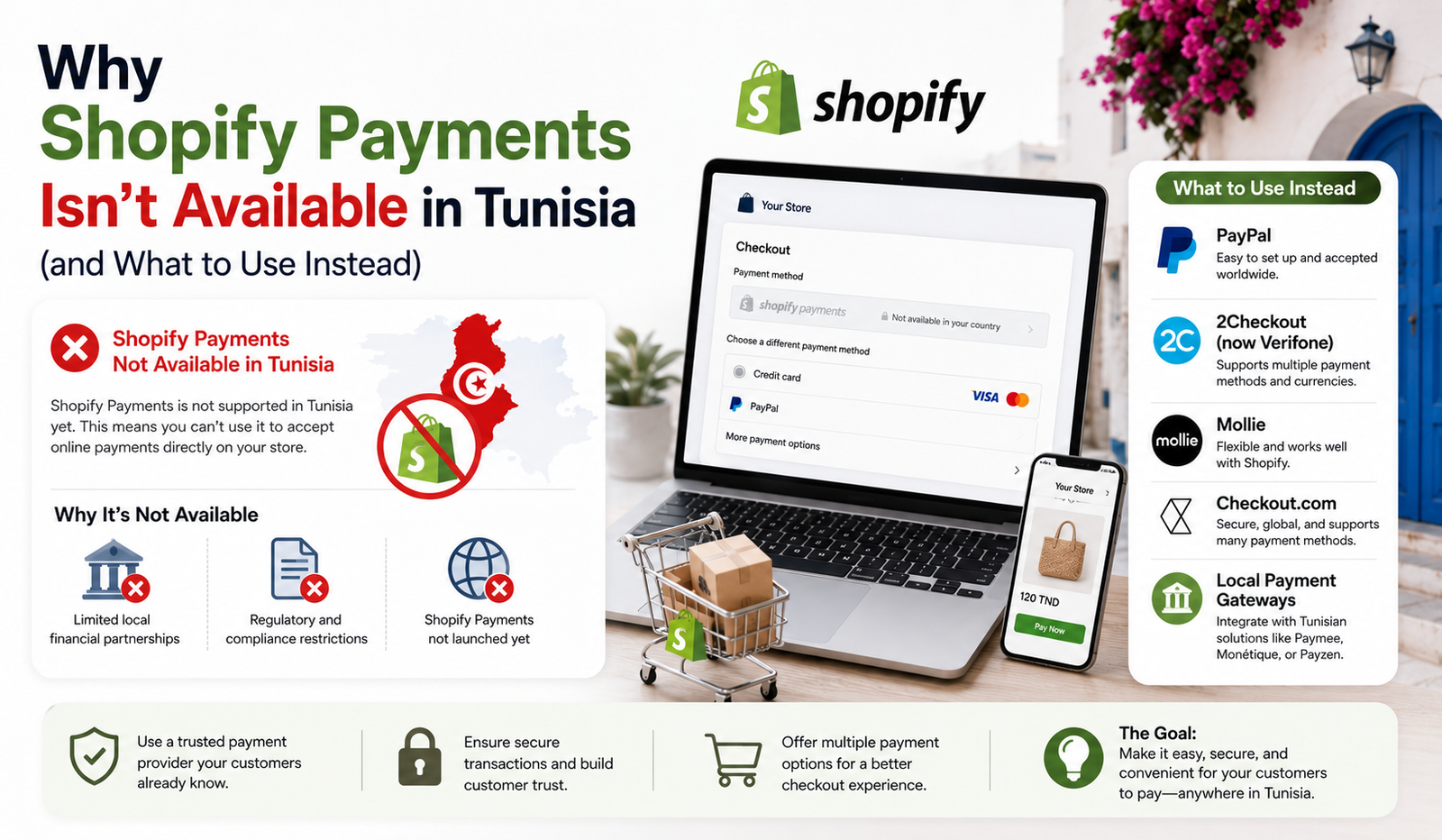
No. Shopify Payments is not available to merchants in Tunisia. As of 2026, Shopify’s own built-in payment processor operates in a limited list of countries and Tunisia is not one of them. If you run a Shopify store registered in Tunisia, you cannot activate Shopify Payments at checkout, and you’ll need a third-party payment gateway instead.
That’s the short answer. But the more useful question, the one this guide actually solves, is what you should use instead, and how to build a checkout that serves both local Tunisian buyers and international customers without losing sales. That’s where most advice online falls short, because it either stops at “it’s not available” or points Tunisian merchants toward tools that quietly don’t work for them.
Let’s fix that.
What Shopify Payments actually is (and why availability matters)
Shopify Payments is Shopify’s own integrated payment processing solution. When it’s available in a country, merchants can accept card payments directly through Shopify without connecting an external payment gateway. The processing, the checkout, and the payouts are handled inside one system.
The catch is that Shopify Payments is powered by underlying banking and card-acquiring infrastructure that Shopify only operates in specific markets. Expanding into a new country isn’t a switch Shopify can flip. It requires local acquiring partnerships, regulatory approvals, currency settlement arrangements, and compliance with each country’s financial rules. That’s why the supported-country list grows slowly and unevenly and why large parts of North Africa, including Tunisia, remain outside it.
For a merchant, the practical consequence is simple: if Shopify Payments isn’t in your country, you route payments through a third-party payment gateway that Shopify supports. The gateway becomes the layer that connects your store to Visa, Mastercard, local card networks, and mobile wallets.
Why Tunisia specifically is excluded
Three factors sit behind Tunisia’s exclusion, and understanding them explains a lot about how payments work locally.
Currency and foreign-exchange controls
The Tunisian dinar (TND) is a regulated, non-freely-convertible currency. The Banque Centrale de Tunisie enforces foreign-exchange controls that shape how money moves in and out of the country. Many Tunisian bank cards are issued for domestic (dinar) use only and cannot be used to pay international merchants by default. A global processor like Shopify Payments has to settle funds, manage cross-border flows, and convert currency — which is far harder to arrange under Tunisia’s FX framework than in a freely convertible market.
Local acquiring infrastructure
Card acceptance in Tunisia is intermediated by the local banking and monetics system rather than the global acquirers Shopify Payments typically relies on. To operate here, a processor generally needs to work through or alongside that local infrastructure. That’s a partnership Shopify has not established.
Market prioritization
Global platforms expand payment coverage where volume and regulatory ease justify the cost. Smaller or more regulated markets tend to wait. This isn’t a judgment on Tunisia’s ecommerce potential, which is real and growing, it’s simply how platform rollouts are sequenced.
None of this is permanent, and none of it stops you from selling. It just means the payment layer is something you assemble deliberately rather than switch on by default.
What this means for your Tunisian Shopify store in practice
Here’s the situation a typical Tunisian merchant faces:
- Your local customers mostly hold TND-denominated cards or prefer cash on delivery. They need a payment method that accepts Tunisian cards and local options.
- Your international customers (including the large Tunisian diaspora in France, Italy, and Germany) want to pay in euros or dollars with international cards.
- Shopify Payments can’t serve either group for you, because it isn’t active in your market.
So the goal isn’t to find “the one gateway.” It’s to build a checkout that covers the payment methods your actual customers use. For many Tunisian stores, that means a local provider for domestic payments, plus where eligible a cross-border option for foreign sales.
The payment routes that actually work in Tunisia
There are three practical routes, and most successful Tunisian stores use a combination.
Route 1 : Local Tunisian payment providers
Providers built for the Tunisian market accept TND payments, local cards, and often mobile-wallet or e-dinar methods. Flouci is the most prominent example and, as of June 2026, offers a native Shopify integration — a first for the Tunisian market. Other local names in the ecosystem include Paymee and Konnect. These providers understand Tunisian card rules and settle in dinar, which makes them the natural backbone for domestic sales.
Route 2 : Multi-provider payment apps
Because no single provider covers every scenario, many merchants use a Shopify app that connects multiple payment gateways through one integration. This is where a Shopify payment gateway for Tunisia like UnumPay fits: rather than committing to one provider, you connect the methods your customers need local and, where you’re eligible, international and manage them from a single dashboard. The advantage is flexibility: if you sell both to Tunisians and to the diaspora, you’re not forced to pick one audience over the other.
Route 3 : Cross-border gateways (eligibility permitting)
Global gateways such as PayTabs, Checkout.com, or Tap serve customers paying in foreign currency. The important caveat: merchant-account eligibility for a Tunisia-registered business varies by provider, and several of these gateways primarily onboard businesses registered in the Gulf or other specific regions. Before you build a stack around one, confirm directly with the provider that they will open an account for a Tunisian entity. Merchants who operate a foreign legal entity for genuine business reasons sometimes have more options here but that’s a real legal and tax decision, not a shortcut.
Local providers vs cross-border gateways: how they compare
| Factor | Local Tunisian providers | Cross-border gateways |
| Primary currency | Tunisian dinar (TND) | EUR, USD, and others |
| Best for | Domestic customers, local cards | International & diaspora customers |
| Tunisian card acceptance | Yes — built for it | Often limited or no |
| Onboarding for a Tunisian business | Designed for it | Varies — confirm eligibility |
| Settlement | Local, in dinar | Cross-border, in foreign currency |
| Typical use | The backbone of a Tunisian store | The add-on for foreign sales |
The pattern most healthy Tunisian stores follow: local provider as the foundation, cross-border option layered on top only if they genuinely sell abroad and qualify for it.
How to choose the right setup for your store
Who are you actually selling to?
If 90% of your orders are domestic, prioritize a strong local provider and don’t over-engineer international coverage you won’t use. If a meaningful share of revenue comes from the diaspora or foreign buyers, you need a genuine cross-border path.
Do your customers expect cash on delivery?
Cash on delivery remains one of the most common payment preferences in Tunisian ecommerce. If your buyers expect it, your setup should support COD alongside card and wallet payments and you should plan for reconciliation and return-to-origin management, which COD makes more complex.
How much operational overhead can you manage?
Running several disconnected payment tools means several dashboards, several reconciliation processes, and more room for error. This is the core argument for a multi-provider app: fewer moving parts, one place to see what’s happening.
Step by step: getting payments live on a Tunisian Shopify store
- Confirm Shopify Payments is unavailable (it is, for Tunisia) and switch your focus to third-party gateways in Shopify’s supported list.
- Choose your local provider for TND and domestic card acceptance for example, a provider with a native Shopify integration.
- Decide whether you need cross-border acceptance. If yes, confirm onboarding eligibility for your Tunisian business before committing.
- Set your store’s currency and markets correctly in Shopify (TND for local; add foreign currencies via Shopify Markets if you sell abroad).
- Connect your gateway(s) either directly or through a multi-provider app that manages them together.
- Enable cash on delivery if your customers expect it, and set up a reconciliation process.
- Test the full checkout with a real local card and, if relevant, an international one before launch.
- Monitor and adjust watch which methods customers actually use and prune what they don’t.
Common mistakes Tunisian merchants make
- Assuming a global gateway will onboard them without checking, then discovering mid-setup that the provider won’t open an account for a Tunisian entity.
- Ignoring cash on delivery because international guides rarely mention it — then losing the large segment of local buyers who prefer it.
- Trying to force Shopify Payments through workarounds instead of building a proper local setup.
- Offering only foreign-currency checkout, which alienates domestic customers whose TND cards can’t complete the payment.
- Running too many disconnected tools, creating reconciliation chaos instead of using one integration.
The through-line: build for the customers you actually have, in the currency and methods they can actually use.
Frequently asked questions
Is Shopify Payments available in Tunisia?
No. Shopify Payments does not support Tunisia as of 2026. Tunisian merchants must use a Shopify-supported third-party payment gateway instead.
Can I use Shopify in Tunisia at all?
Yes. You can build and run a Shopify store from Tunisia only if the built-in Shopify Payments processor is unavailable. You accept payments through third-party gateways connected to your store.
What is the best payment gateway for a Tunisian Shopify store?
There’s no single “best” it depends on who you sell it to. Local providers (such as Flouci, which now offers a native Shopify integration) are the backbone for domestic TND payments, while multi-provider apps let you combine local and, where eligible, international methods in one setup.
Why can’t Tunisian cards pay on some international sites?
Many Tunisian bank cards are issued for domestic dinar use and are restricted from international transactions under the country’s foreign-exchange rules. This is why a local payment provider is essential for accepting domestic cards.
Can I accept euros or dollars from customers abroad?
Potentially, yes through a cross-border gateway but merchant-account eligibility for a Tunisia-registered business varies by provider. Confirm directly with the gateway before planning your checkout around it.
Is cash on delivery worth supporting in Tunisia?
For many stores, yes. Cash on delivery remains a common preference in Tunisian ecommerce, so supporting it with a proper reconciliation process can meaningfully reduce abandoned orders.
Does Shopify Payments plan to launch in Tunisia?
Shopify has not announced plans to launch Shopify Payments in Tunisia. Check Shopify’s official supported-countries page for the current status rather than relying on predictions.